

Table of Contents
How to choose the best IOP or PHP program is an important question for anyone considering treatment. It can be difficult to know where to begin when thinking about an Intensive Outpatient Program (IOP) or a Partial Hospitalization Program (PHP). You can locate a program that genuinely aids in your healing process by asking the right questions.
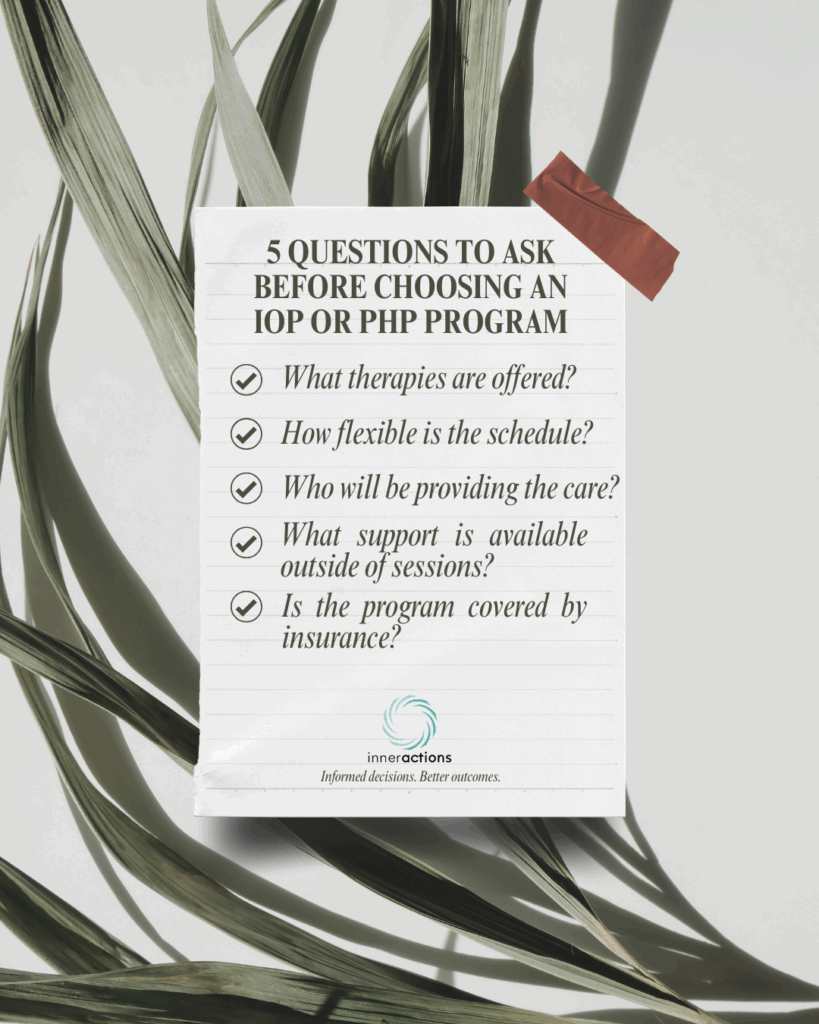
Before choosing an IOP or PHP program, consider these five crucial questions.
What Services and Therapies Are Provided?
Every program uses a different strategy. While some might emphasize evidence-based treatments like Dialectical Behavior Therapy (DBT) or Cognitive Behavioral Therapy (CBT), others might also incorporate more holistic choices like yoga, mindfulness, or dietary counseling.
Why it matters: Your needs should be met by the therapies that are offered. Make sure the program provides trauma-informed care, for instance, if trauma is a part of your story.
How Flexible is the Schedule?
A good IOP will also offer a virtual option that can fit with your schedule and make treatment more accessible. The number of hours per day and days per week that PHPs and IOPs require can vary. Some programs operate in the morning, while others are held in the evening.
Why it matters: Flexibility — whether in-person or virtual — allows you to balance treatment with family, work, or school obligations. To stay committed and consistent, choose a program that offers scheduling options that fit your life.
Who Will Be Providing the Care?
Your experience is greatly influenced by the individuals facilitating both individual and group sessions. Peer support specialists, case managers, psychiatrists, and therapists may be part of the programs.
Why it matters: Seek out qualified, experienced experts who are aware of the particular difficulties you are facing in addition to having credentials. Inquire about the credentials and background of the staff in relation to co-occurring substance use or mental health.
What Kind of Help Is Offline?
The course of treatment doesn’t stop when you leave. Some programs provide access to support in between sessions, alumni groups, or family therapy.
Why it matters: Having a solid support network is essential for recovery. Long-lasting change is facilitated by a program that provides resources outside of formal treatment.
Is the Program Covered by Insurance?
Cost is often one of the biggest factors in choosing a program. Ask if the program accepts your insurance, what your out-of-pocket costs will be, and whether financial assistance is available.
Why it matters: Understanding the financial side upfront reduces stress and allows you to focus fully on your recovery.
Final Thoughts on How to Choose the Best IOP or PHP Program
Choosing an IOP or PHP program is a significant decision, and you should feel secure in your choice. You can locate a program that meets your needs and aids in laying a solid foundation for recovery by posing the appropriate questions.
These and other questions can be answered at Inneractions IOP, a program within the AM Health Care family. Get in touch with us right now if you’re considering treatment options; our staff is prepared to guide you through the steps and assist you in moving forward.
Or call us directly to speak with our admissions team 1-866-780-4046
Frequently Asked Questions About Choosing the Best IOP or PHP Program
What’s the difference between IOP and PHP?
Higher level care is provided by a PHP (Partial Hospitalization Program), which usually entails more therapy hours per day, frequently five days a week. With therapy taking place several days a week for a few hours at a time, an intensive outpatient program, or IOP, requires less time. While IOP can be used as a starting point for individuals who do not require round-the-clock care or as a step-down from PHP, PHP is frequently used as a step-down from residential care.
How long do IOP and PHP programs usually last?
While PHPs may run for 4–6 weeks, IOPs typically last 8–12 weeks, though program length can vary based on individual needs. Your treatment team will evaluate your progress on a regular basis and modify the schedule as necessary.
Can I work or go to school while attending IOP?
Indeed. An IOP’s primary benefit is that it gives you structured support while enabling you to continue with obligations like work or school. PHP’s greater intensity might necessitate more schedule modifications.
Do I need to complete residential treatment before IOP or PHP?
Not all the time. If their symptoms can be controlled without round-the-clock assistance, some people start with IOP or PHP. Others may transition into IOP or PHP after completing residential care. Your clinical needs will determine the best place to start.
Will insurance cover IOP or PHP?
Although coverage varies, many insurance companies offer coverage for both PHP and IOP programs. To find out what your plan covers and what your potential out-of-pocket expenses are, it’s crucial to confirm your insurance in advance.
